
Why Two Nearly Identical Houses Can Sell $30,000 ApartYou pull up two homes in the same neighborhood.Both have four bedrooms. Both have three bathrooms. They're within a couple hundred square feet

Dated: September 21 2026
Views: 74
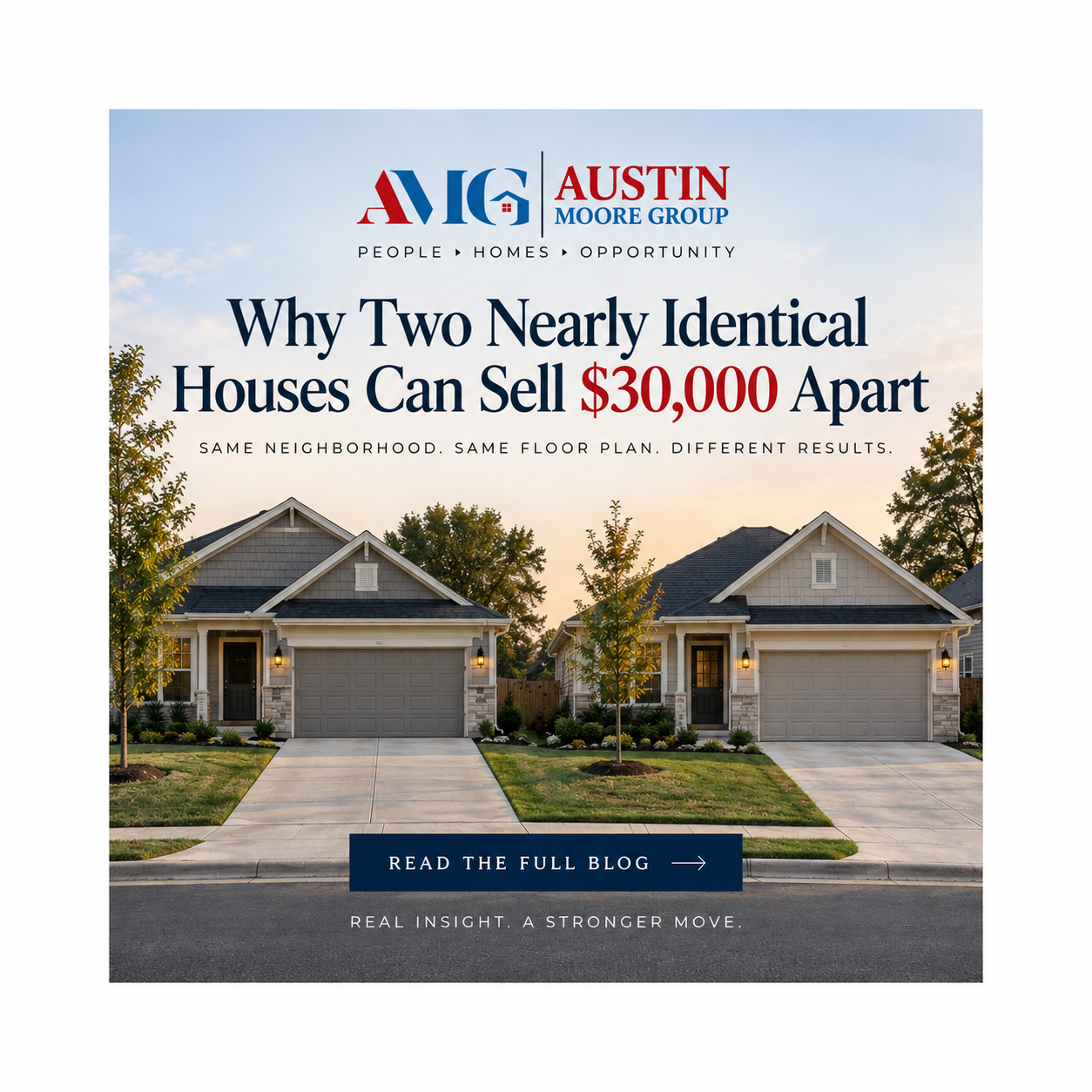 Why Two Nearly Identical Houses Can Sell $30,000 Apart
You pull up two homes in the same neighborhood.
Both have four bedrooms. Both have three bathrooms. They're within a couple hundred square feet of each other. They were built around the same time and may even have the exact same floor plan.
One sells for $425,000.
The other sells for $455,000.
How does that happen?
As a Realtor, I see this all the time. Two houses can look nearly identical on paper but have dramatically different results when they hit the market.
Here are some of the biggest reasons why.
Buyers don't just compare square footage and bedroom count. They're calculating what they'll have to spend after closing.
Imagine two identical houses.
One has a 15-year-old HVAC system, worn carpet, dated paint and an aging roof.
The other has newer mechanicals, fresh paint, updated flooring and a newer roof.
Even if the houses are technically comparable, buyers aren't going to value them the same way.
And sometimes the difference isn't necessarily the actual cost of the improvements. It's the perception of having a home that's ready to move into without immediately tackling projects.
I've seen good houses get overlooked because they simply didn't show well.
Dark rooms, too much furniture, clutter, unusual paint colors and poor listing photos can make a home feel smaller or less desirable than it actually is.
Meanwhile, the house down the street may have:
Professional photography
Clean, bright rooms
Less clutter
Better furniture placement
Fresh paint
Better curb appeal
The homes might be nearly identical, but buyers experience them completely differently.
And in real estate, perception matters.
Same subdivision doesn't always mean same location.
One house might back to trees or sit on a quiet cul-de-sac.
The other might back to a busy road.
One could have a large, flat backyard while another has a steep or unusually shaped lot.
Corner lots, walkout basements, privacy, views and even where the house sits within the neighborhood can affect what buyers are willing to pay.
You can't see most of that by simply comparing bedrooms, bathrooms and square footage.
Sellers sometimes tell me:
"We've put $50,000 into this house."
That's great — but the next question is where did the $50,000 go?
Replacing a roof, HVAC system and windows is valuable, but buyers may react differently to those improvements than they do to a beautifully remodeled kitchen.
Likewise, spending $30,000 on highly personalized improvements doesn't automatically increase the home's market value by $30,000.
The updates buyers value most can also vary depending on the neighborhood and price point.
That's why it's important to look at improvements through the eyes of today's buyer rather than simply adding up receipts.
This sounds backwards, but starting higher doesn't always mean selling higher.
Suppose a home is realistically worth somewhere around $450,000.
Seller A lists at $449,900 and generates significant activity during the first weekend.
Seller B lists a similar house at $479,900 because they want to "leave room to negotiate."
Seller A may create competition.
Seller B may spend several weeks on the market before eventually reducing the price.
By then, buyers may start wondering:
"Why hasn't this house sold?"
The first few weeks on the market can be incredibly important. Pricing isn't just about determining what you want for the house. It's about positioning the property against everything else buyers can choose from.
Real estate values don't exist in a vacuum.
Imagine House A hits the market when there are very few similar homes available.
Three qualified buyers want it.
Now imagine House B lists two months later and suddenly there are seven comparable properties competing for the same buyers.
Same neighborhood. Same floor plan.
Completely different environment.
Interest rates, inventory, buyer demand, seasonality and even what happens in a particular price bracket can influence the final result.
The final number recorded as the sale price doesn't always tell the entire story.
A house could sell for $450,000 with the seller contributing money toward the buyer's closing costs.
Another might sell for $445,000 with no seller concessions.
Which seller actually had the better result?
You have to look deeper.
Repairs, inspection negotiations, closing-cost credits, home warranties and other concessions can change the seller's actual proceeds.
That's why I don't like evaluating a comparable sale based solely on the headline sale price.
Putting a house in the MLS is the starting point — not the entire marketing strategy.
Photography, video, social media, online presentation, agent-to-agent marketing, database exposure, showing accessibility and how the property's best features are communicated can all influence buyer interest.
Good marketing can't magically make a $400,000 house worth $500,000.
But poor marketing can absolutely prevent a good property from getting the attention it deserves.
There usually isn't one answer.
It could be condition.
It could be the lot.
It could be updates.
It could be timing.
It could be pricing.
It could be marketing.
And usually, it's a combination of several of them.
This is also why simply looking at what your neighbor's house sold for — or relying on an online estimate — doesn't always tell you what your home would sell for today.
A good home valuation should compare the numbers and understand the differences behind those numbers.
Before deciding what your home is worth, I recommend looking at the property the same way today's buyers will.
What are the strongest features?
What could hurt the first impression?
Which improvements actually matter?
What are buyers choosing between right now?
And how should the home be positioned against that competition?
That's the difference between simply putting a price on a house and developing a strategy to sell it.
Austin Moore
The Austin Moore Group
Serving buyers and sellers throughout Blue Springs, Lee's Summit, Grain Valley, Independence, Warrensburg and surrounding Kansas City communities.
austinsellsmoore.com

I grew up in a smaller town of about 10,000 people in Fulton, Missouri. After graduating high school and leaving Fulton, I then ventured to both Central Methodist University and the University Of Cent....
Why Two Nearly Identical Houses Can Sell $30,000 ApartYou pull up two homes in the same neighborhood.Both have four bedrooms. Both have three bathrooms. They're within a couple hundred square feet
The Federal Reserve Raised Interest Rates—What Does That Mean for Mortgage Rates?For the first time since 2023, the Federal Reserve has raised its benchmark interest rate.On September 16,,
5 Signs You’ve Outgrown Your Current HomeBuying a home that fits your life today is one thing. Finding a home that continues to fit your life five or ten years later is another.Families grow.
Jackson & Johnson County Housing Market Update: What the Latest 2026 Numbers Tell UsIf you've been waiting for home prices to fall significantly in the Kansas City area, the latest numbers aren
 The information displayed on this page is confidential, proprietary, and copyrighted information of Heartland Multiple Listing Service, Inc. (
Heartland MLS
). Copyright 2026, Heartland Multiple Listing Service, Inc. Heartland MLS and Austin Moore Group do not make any warranty or representation concerning the timeliness or accuracy of the information displayed herein. In consideration for the receipt of the information on this page, the recipient agrees to use the information solely for the private noncommercial purpose of identifying a property in which the recipient has a good faith interest in acquiring. Data last updated on September 22, 2026 5:42 PM UTC
33. Required DMCA Notice
The Digital Millennium Copyright Act of 1998, 17 U.S.C. §512, the DMCA, provides recourse for copyright owners who believe that material appearing on the Internet infringes their rights under U.S. copyright law. If you believe in good faith that any content or material made available in connection with our website or services infringes your copyright, you (or your agent) may send us a notice requesting that the content or material be removed, or access to it blocked. Notices must be sent in writing by email to DMCAnotice@MLSGrid.com. The DMCA requires that your notice of alleged copyright infringement include the following information: (1) description of the copyrighted work that is the subject of claimed infringement; (2) description of the alleged infringing content and information sufficient to permit us to locate the content; (3) contact information for you, including your address, telephone number and email address; (4) a statement by you that you have a good faith belief that the content in the manner complained of is not authorized by the copyright owner, or its agent, or by the operation of any law; (5) a statement by you, signed under penalty of perjury, that the information in the notification is accurate and that you have the authority to enforce the copyrights that are claimed to be infringed; and (6) a physical or electronic signature of the copyright owner or a person authorized to act on the copyright owners behalf. Failure to include all of the above information may result in the delay of the processing of your complaint.
 All information deemed reliable but not guaranteed. All properties are subject to prior sale, change or withdrawal. Neither listing broker(s) or information provider(s) shall be responsible for any typographical errors, misinformation, misprints and shall be held totally harmless. Listing(s) information is provided for consumer's personal, non-commercial use and may not be used for any purpose other than to identify prospective properties consumers may be interested in purchasing. The data relating
to real estate for sale on this website comes in part from the Internet Data Exchange program of the Multiple Listing Service. Real estate listings held by brokerage firms other than Austin Moore Group may be marked with the Internet Data Exchange logo and detailed information about those properties will include the name of the listing broker(s) when required by the MLS. Copyright ©2026 All rights reserved.
Last Updated: September 22, 2026 6:00 PM UTC
Show More...
All information deemed reliable but not guaranteed. All properties are subject to prior sale, change or withdrawal. Neither listing broker(s) or information provider(s) shall be responsible for any typographical errors, misinformation, misprints and shall be held totally harmless. Listing(s) information is provided for consumer's personal, non-commercial use and may not be used for any purpose other than to identify prospective properties consumers may be interested in purchasing. The data relating
to real estate for sale on this website comes in part from the Internet Data Exchange program of the Multiple Listing Service. Real estate listings held by brokerage firms other than Austin Moore Group may be marked with the Internet Data Exchange logo and detailed information about those properties will include the name of the listing broker(s) when required by the MLS. Copyright ©2026 All rights reserved.
Last Updated: September 22, 2026 6:00 PM UTC
Show More...
